
Scale Smart: Building Financial Systems Before You Need Them
For hardware founders, financial challenges surge when growth accelerates — when prototypes become production runs, when purchase orders multiply, and when every operational decision starts to affect cash flow and manufacturing timelines.
This reality was at the center of Scale Smart – Building Financial Systems Before You Need Them, a recent mHUB workshop led by Alex Brenlla, Project Manager at Ramp. The session explored why hardware startups must establish strong financial infrastructure early, and how proactive systems can prevent bottlenecks that commonly slow scaling companies.
Why Hardware Startups Need Systems Early
Alex opened by describing how spending discipline evolves over time. In the first year, every decision is intentional. Ten years later, without structure, subscriptions renew unnoticed, expenses slip into miscellaneous categories, and founders lose visibility into the true financial picture.
He summarized the shift clearly:
“First year in business you're running the business. 10 years later, without systems in place, the business is running you.”
For hardware startups — where every dollar ties to materials, supply chain, fabrication, and testing — this lack of clarity can delay production, inflate unit economics, and complicate investor conversations.
Preventing Scaling Bottlenecks
A central theme of the workshop was preventing the operational drag that appears as companies grow. Hardware founders often manage more complex operations than software teams: vendor payments, long lead times, inventory, procurement cycles, and equipment purchases.
Without strong financial systems, it becomes difficult to track spending, consolidate vendor invoices, or close monthly books efficiently. This can stall progress at the exact moment a startup needs to move quickly — during pilot deployments, manufacturing contracts, or new funding rounds.
Alex emphasized that exponential growth doesn’t come with a warning, making proactive financial systems a strategic advantage rather than a back-office detail.
Automating Manual Work and Staying Audit-Ready
The workshop demonstrated how automation can reduce the manual processes that drain early-stage teams — downloading receipts, manually coding expenses, or reconciling payments in spreadsheets.
Ramp’s automated workflows help teams capture receipts instantly, categorize expenses, and maintain clean financial records without disrupting engineering or customer work. For hardware startups, this means fewer delays when reporting reimbursable grant expenses, fewer errors in vendor payments, and faster month-end close.
Alex shared that automated systems are designed to give founders time back so they can focus on high-impact work, not bookkeeping.
Built-In Guardrails as Teams Grow
As hardware teams scale, founders need visibility into spending across travel, materials, conferences, and vendor purchases. Guardrails built directly into cards or spend programs help maintain alignment without micromanaging employees.
These controls ensure spending stays in policy, reduce accidental overspending, and protect valuable runway — critical for startups transitioning from prototype to production.
Consolidating the Financial Stack
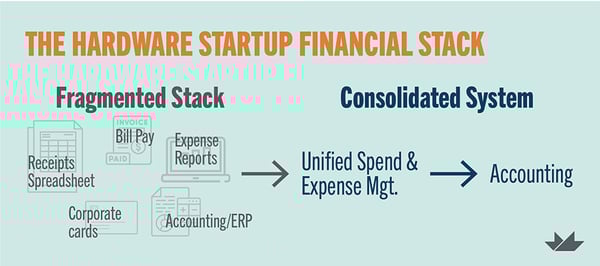
Many early-stage teams juggle multiple disconnected tools: corporate cards, bill pay platforms, expense reporting systems, and accounting software. But in hardware, where the volume of vendor payments grows quickly, fragmentation leads to blind spots.
Alex highlighted how consolidating non-payroll spend (corporate cards, accounts payable, and expense management) into a single platform improves accuracy and speeds up financial processes. For founders, this results in better cash visibility, fewer duplicate payments, and a more reliable financial foundation.
Systems as a Strategic Advantage
Alex closed with a reminder that systems are not something to adopt after growth — they are a prerequisite for growth:
“You never know when the exponential growth is coming, and you don't want to be playing catch up.”
For mHUB’s community of hardware innovators, investing early in financial systems ensures smoother scaling, stronger operational efficiency, and better preparation for manufacturing, partnerships, and fundraising.
mHUB will continue to host workshops that equip founders not only to build breakthrough technology, but to scale it with confidence.
For more insights on how to move from prototype to go-to-market strategy:
-
Explore mHUB workshops and events: mhubchicago.com/events
-
Subscribe for updates: mhubchicago.com/subscribe
-
Consider joining the mHUB community: mhubchicago.com/apply-to-be-a-member